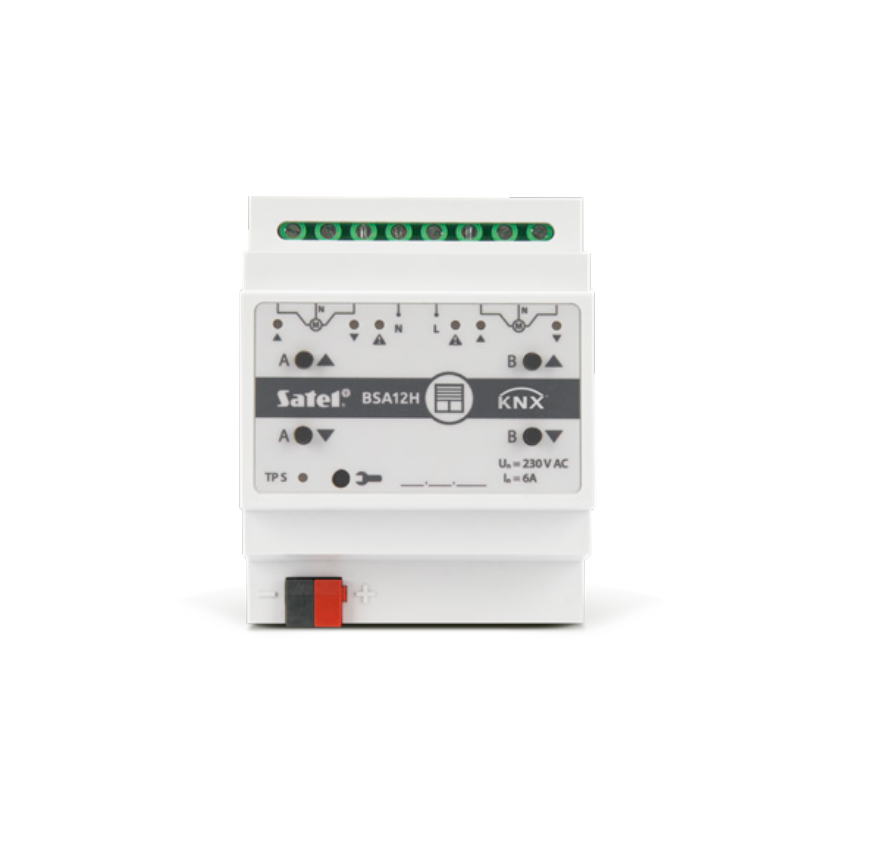
KNX blind and shutter actuator SATEL KNX-BSA12H DIN module 2 channels 230 V AC 6 A IP20
- KNX-BSA12H blind actuator for controlling blinds, shutters, awnings and windows with 230 V AC motor; 2 logic channels; KNX bus supply voltage 20...30 V DC.
Subscription products in your shopping cart
Set one delivery frequency for all subscription products in your cart every:
Subscription products in your shopping cart
KNX-BSA12H KNX blind actor module for controlling blinds and windows with 230 V AC drive
KNX-BSA12H is a KNX system shutter actuator for controlling the movement of curtains, blinds, awnings and windows with 230 V AC drive. The device has two physical outputs corresponding to two logical channels, each of which can control one selected type of curtain or window.
- KNX blind actuator for controlling blinds, shutters, awnings and windows.
- Two physical outputs and two logical channels, each for one type of curtain or window.
- Communication with KNX bus via integrated bus connector.
- Automatic detection of the curtain travel time and slat adjustment time.
- Manual control of curtain travel via buttons on the housing.
Application and functions of the KNX-BSA12H module
The KNX-BSA12H module is designed for building automation in the KNX system and is used to control devices equipped with a 230 V AC motor, such as horizontal (Venetian) blinds, roller blinds, awnings and motorized windows. With two logical channels, it is possible to control two curtains or windows independently, while selecting the type of curtain for each channel separately.
The device provides feedback on the status of the module and individual channels, making it possible to monitor the position of the curtains and the correctness of operation. The KNX-BSA12H supports weather alarms (rain, wind, frost), a position override function, and the ability to call scenes for each channel using 1- and 8-bit commands, allowing integration into advanced building automation scenarios.
Operation, configuration and installation
The KNX-BSA12H module communicates with the KNX bus via an integrated bus connector and is powered by 20...30 V DC from the KNX bus. Configuration of the device is carried out using ETS software, which allows detailed setting of operating parameters, curtain types, response to weather alarms and scene logic.
On the module's housing there are buttons for manual control of the curtains' movement and LEDs showing the status of each channel or curtain. The device is suitable for mounting on a 35 mm DIN rail, occupies 4 bays on the rail and has a 70 x 92 x 60 mm housing, making it easy to install in standard building automation switchboards.
Parameters expLoatation and electrical
The KNX-BSA12H is designed to operate in typical building automation environments, with an operating temperature range of 0°C to +45°C and a temperature range for storage and transport of -25°C to +70°C. The IP20 degree of protection means that the device is designed for indoor installation in properly protected switchgear.
The module has a KNX bus current consumption of less than 20 mA and a rated load supply voltage of 230 V AC. The permanent current carrying capacity of the contact is 6 A, and the maximum cross-section of the connection cable is 2.5 mm². In addition, the design of the device takes into account protections to detect a curtain error, such as lack of power supply, incorrect position, mechanical jamming or motor overheating.
Technical data
| Parameter | Value |
|---|---|
| Type of device | KNX shutter actuator |
| Purpose | Control of horizontal (Venetian) blinds, roller blinds, awnings and motorized windows |
| Motor type of controlled devices | 230 V AC motor |
| Number of physical outputs | 2 |
| Number of logical channels | 2 |
| Selectable type of curtain for the channel | Yes, separately for each channel |
| Communication with KNX bus | Integrated bus connector |
| KNX bus current consumption | < 20 mA |
| Supply voltage (KNX bus) | 20...30 V DC |
| Rated voltage Uₙ | 230 V AC |
| Permanent contact current carrying capacity Iₙ | 6 A |
| Weather alarms | Rain, wind, frost |
| Additional functions | Position override function, ability to call scenes for each channel (1- and 8-bit commands) |
| Security features | Curtain error detection: no power, wrong position, mechanical jam, motor overheating |
| Manual control | Buttons on the housing to control curtain travel |
| Status signaling | LEDs showing the status of each channel/curtain |
| Configuration | ETS software |
| Mounting options | On a 35 mm DIN rail |
| Number of fields on DIN rail | 4 |
| Housing dimensions | 70 x 92 x 60 mm |
| Operating temperature range | 0°C...+45°C |
| Storage/transport temperature range | -25°C...+70°C |
| Protection degree | IP20 |
| Maximum tightening torque | 0.5 N-m |
| Maximum cable cross-section | 2.5 mm² |
| Maximum number of communication objects | 45 |
| Maximum number of group addresses | 256 |
| Maximum number of associations | 256 |
Technical data source: datasheet of the KNX-BSA12H model Link
FAQ - frequently asked questions
What is the KNX-BSA12H module used for?
KNX-BSA12H is used to control the movement of horizontal blinds, roller blinds, awnings and motorized windows in the KNX building automation system.
How many control channels does the KNX-BSA12H have?
The module has two physical outputs and two logical channels, each of which can control one type of curtain or window.
What power supply voltage is required for the module to operate?
The module is powered from the KNX bus with a voltage of 20...30 V DC, and the controlled devices operate at a nominal voltage of 230 V AC.
What is the maximum continuous current load of the contact?
The continuous current load capacity of the contact is 6 A.
Does the KNX-BSA12H enable automatic detection of curtain travel time?
Yes, the module automatically detects the curtain travel time and slat shift time.
Can a different type of curtain be set for each channel?
Yes, the type of controlled curtain or window can be individually selected for each channel.
What weather alarms does the KNX-BSA12H support?
The module supports weather alarms related to rain, wind and frost.
Does the module allow the creation of scenes in the KNX system?
Yes, scenes can be invoked for each channel using 1- and 8-bit commands.
How is the status of the channels signaled?
The status of each channel or curtain is presented by LEDs located on the module housing.
Does the KNX-BSA12H allow manual control of the curtains?
Yes, there are buttons on the housing that allow you to manually control the movement of the curtain.
How is the KNX-BSA12H module configured?
The module is configured using the ETS software designed for the KNX system.
What is the temperature range of the device?
The module operates in the temperature range from 0°C to +45°C.
What is the temperature range for storage and transportation?
The temperature range for storage and transportation is -25°C to +70°C.
What is the protection degree of the KNX-BSA12H housing?
The protection degree of the module's housing is IP20, which means for indoor installation.
On what rail is the module mounted?
The module is designed to be mounted on a standard DIN rail with a width of 35 mm.
How many DIN rail bays does the KNX-BSA12H occupy?
The KNX-BSA12H occupies 4 fields on a DIN rail.
What is the maximum cross-section of the connection cable?
The maximum cross-section of the connection cable is 2.5 mm².
How many communication objects does the module support?
The module supports a maximum of 45 communication objects.
How many group addresses can be assigned to the KNX-BSA12H?
A maximum of 256 group addresses can be assigned to the module.
How many associations does the device support?
The device supports a maximum of 256 associations in the KNX system.
Summary
KNX-BSA12H is a specialized KNX shutter actuator for controlling 230 V AC motorized curtains, blinds, awnings and windows, equipped with two independent control channels and extensive automation functions. The device offers a wide range of technical parameters, support for weather alarms, scene functions and convenient manual control, making it a universal component of building automation installations.